

Everything you need to live your best no-alcohol / low-alcohol lifestyle.
Understanding dopamine and alcohol can help explain why quitting drinking does not always lead to an immediate burst of energy, motivation and happiness.
There is a common assumption that when you stop drinking alcohol, you should start feeling fantastic almost immediately. Better sleep, more energy, improved mood and greater motivation.
There is also an assumption that withdrawing from alcohol simply means getting through a difficult first week and then steadily feeling better. In reality, recovery can be much less predictable.
The brain and body do not simply flick a switch from “drinking” to “recovered”. Reward, stress, sleep and motivation systems can take time to adjust, particularly after regular or heavy alcohol use.
For people withdrawing from alcohol after heavy or dependent drinking, suddenly stopping can be medically dangerous. Withdrawal can vary significantly from person to person, and some people may need medical support to reduce or stop alcohol safely.
If you drink heavily, experience withdrawal symptoms or are concerned that you may be dependent on alcohol, speak with a doctor or qualified health professional before suddenly stopping.
The relationship between dopamine and alcohol is particularly important when looking at reward and motivation. Alcohol activates brain systems involved in reward processing, including dopamine signalling. Over time, the brain can learn to associate alcohol with particular people, places, emotions and routines.
With repeated heavy drinking, the brain’s reward and stress systems can adapt. When alcohol is removed, some people may temporarily experience reduced reward, stronger stress responses, cravings or difficulty enjoying ordinary activities while those systems continue to adjust.
Alcohol interacts with several systems involved in reward, motivation, stress and relaxation, including dopamine and GABA. Dopamine and alcohol interact within brain systems involved in reward, motivation and learning. Dopamine helps the brain learn which experiences are rewarding and which cues are associated with those rewards. Alcohol also affects other neurotransmitter systems, including GABA and glutamate, which influence brain activity, relaxation and excitability.
With regular or heavy drinking, the brain adapts to maintain balance. In essence, these brain functions get used to operating less or more depending on the stage of drinking we are in. When alcohol is removed, those systems need time to recalibrate.
That adjustment may help explain why the first few weeks without alcohol can feel uneven – at times energised and at others totally fatigued.
During this early stage, changes involving dopamine and alcohol may be only one part of what you are experiencing. Sleep disruption, stress responses, established routines and learned drinking cues can all influence how the first days feel.
One useful thing that is sometimes not so obvious is decision fatigue. Tasks and choices that would ordinarily feel simple can suddenly require considerably more mental effort. This doesn’t necessarily mean something is wrong. Your brain and nervous system are adapting to functioning without alcohol.
Sleep may also be disrupted initially. Alcohol affects normal sleep patterns, so removing it can temporarily change both the quality and pattern of sleep. If you are used to going to bed after several drinks, and falling straight to sleep, it may take you time to get used to falling asleep without the aid of alcohol. Reading (not screen time) or meditating can help you wind down for sleeping. Some people experience particularly vivid dreams as normal sleep cycles begin to re-establish themselves.
Rather than judging progress solely by how good or bad you feel on any particular day, it can be more useful to notice broader changes in sleep, concentration and your ability to manage everyday decisions. Try not to judge every uncomfortable change as either good or bad. Some symptoms may reflect changes in sleep, stress or brain adaptation rather than alcohol literally remaining in your body.
By the second week, many people begin noticing genuine improvements. Sleep may improve. Energy may start returning. Thinking can feel clearer and everyday tasks may become easier.
This can create an interesting psychological assumption: “I feel better, so perhaps the problem is fixed.”
Feeling better is certainly a sign of progress. But it doesn’t necessarily mean the brain and body have completed their adjustment. As you start feeling clearer or more energised, notice what moments stand out.
One thing worth observing at this stage is how naturally rewarding ordinary experiences feel. Your body has been used to alcohol being the “feel good” moment, so now is a good time to start noticing new (or old) experiences that start to reappear. Does good news genuinely register? Do you enjoy a conversation, a meal, exercise, music or completing something you’ve been working on?
This is where understanding dopamine and alcohol becomes useful. Recovery is not necessarily about suddenly producing more dopamine. It is more about the brain gradually adapting to life without alcohol repeatedly driving and reinforcing its reward pathways.
The gradual return of pleasure from everyday experiences may be more meaningful than simply asking, “Am I in a good mood today?”
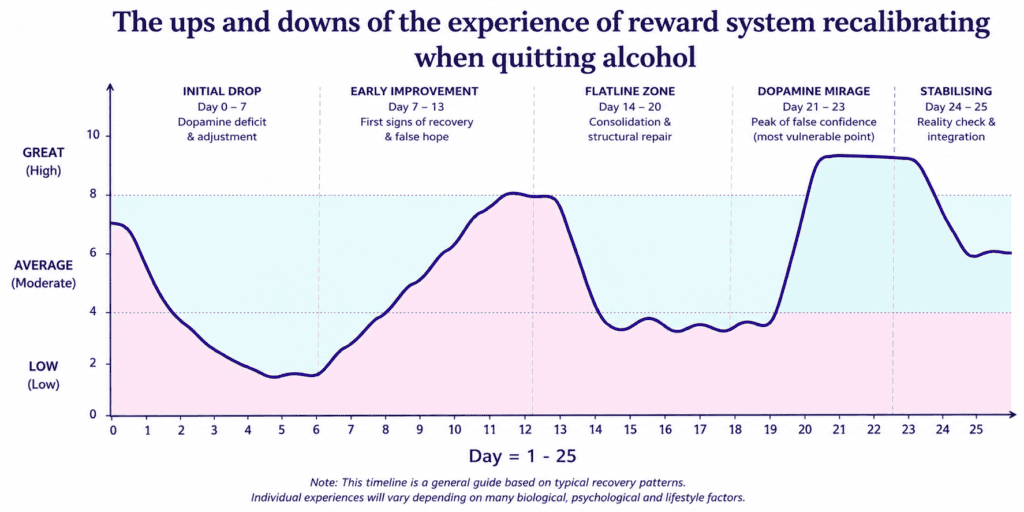
A temporary flat period is sometimes interpreted as a sign that dopamine has not “reset”. In reality, the relationship between dopamine and alcohol is more complex, and there is no universal timetable for the brain’s reward system to return to a particular baseline.
After the initial improvements, some people experience a period where things simply feel… flat. Not terrible. Not wonderful. Just a bit beige.
That can be confusing, particularly if you expected every alcohol-free week to feel progressively better than the one before it. But a plateau doesn’t necessarily mean you’re going backwards.
Instead of measuring progress purely through mood, look for changes in your thinking.
Are you thinking further ahead? Is planning becoming easier? Is greater clarity slowly appearing? Are you less focused on simply getting through today? Are ordinary experiences starting to feel rewarding again?
These changes may be less dramatic than a sudden burst of energy or elevated mood, but they can be important signs that your brain and behaviour are continuing to adjust.
There can also be a particularly interesting stage after a few alcohol-free weeks.
By now, you’re sleeping better, thinking more clearly and social situations may feel easier. You might genuinely feel better than you have for quite some time.
And then comes the thought: “See? Now that I’ve fully detoxed, maybe I can drink again – just once in a while.”
If your initial goal was to take a temporary break from alcohol, feeling better after a few weeks may naturally lead you to reconsider what comes next. However, there is no universal point at which the brain can be declared completely “reset”.
Research suggests that some alcohol related changes in brain function can improve over months of abstinence, but recovery varies considerably between individuals. How much and how often someone drank, their health, biology, sleep, stress and whether alcohol dependence was present can all influence the process.
But if abstinence is your goal, the three-week mark is a time where your mind may be playing tricks on you. That thought can be surprisingly convincing because it arrives precisely when things are going well.
Over longer periods, the relationship between dopamine and alcohol may become less noticeable in everyday life as alcohol related cues lose some of their influence and ordinary activities begin to feel more rewarding again.
This is why it can be useful to treat the first few weeks as a period of observation rather than constantly testing whether you can now “handle” alcohol differently.
Notice what is changing. Notice what is becoming easier. And give those changes time to settle.
As time goes on, the changes may become less dramatic but more significant.
Natural sources of reward — connection, achievement, food, movement, creativity, relaxation and everyday pleasure — can begin to occupy more space again.
One surprisingly useful sign of adjustment may be something we rarely celebrate:
Being bored and being completely okay with it.
Boredom doesn’t need to be immediately fixed, escaped or rewarded. A quiet afternoon can simply be a quiet afternoon. Thoughts about drinking may still occur, particularly when alcohol has previously been strongly associated with particular people, places, emotions or routines.
The important shift isn’t necessarily that the thought never appears. It’s that the thought has less pull. There’s a significant difference between thinking about having a drink and feeling compelled to have one.
There probably isn’t a magical Day 10, Day 21 or Day 90 when everybody’s dopamine system suddenly announces: Congratulations. Reset complete. Brains are considerably more complicated — and individual — than that.
How someone adjusts after stopping alcohol will depend on many things, including how much and how often they were drinking, how long they had been drinking that way, their health, sleep, stress, environment and individual biology.
But understanding that adjustment takes time can be enormously helpful.
A difficult first week doesn’t necessarily mean life without alcohol will always feel difficult or that things will get steadily better from day seven onwards. A flat third week doesn’t necessarily mean nothing is changing. And feeling fantastic after a few weeks doesn’t necessarily mean the process is finished.
Sometimes the most important changes aren’t dramatic at all. They’re simply the gradual return of the capacity to enjoy, be present, engage with — and occasionally be pleasantly bored by — ordinary life.
