Everything you need to live your best no-alcohol / low-alcohol lifestyle.


Everything you need to live your best no-alcohol / low-alcohol lifestyle.
Across Australia, something interesting is happening. More people are choosing to drink less — or not at all — and it’s no longer just a “sober curious” fringe movement. It’s becoming part of everyday life.
While all generations are adopting the trend to various degrees, the shift isn’t happening evenly. Younger generations are leading the change, while older Australians are moving more slowly, as seen in these estimated figures (based on a review of recent studies).
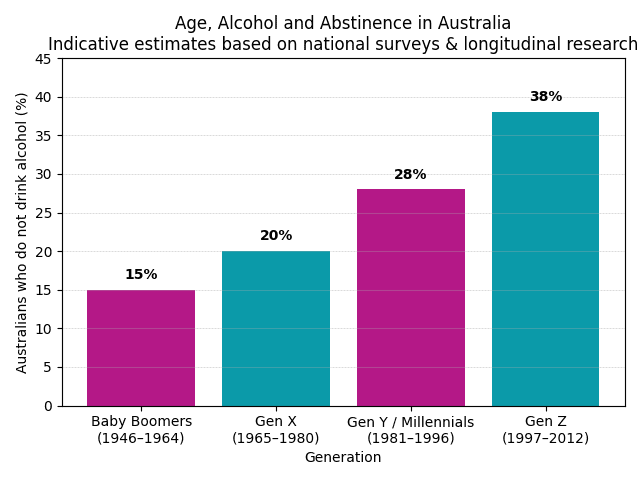
What’s apparent is that how much we drink, why we drink, and why we choose not to drink is best understood within a generational context.
Baby Boomers: Health Takes Priority
For many Baby Boomers, cutting back on alcohol is about health and wellbeing.
Retirement brings fewer work functions, fewer late nights, and more space to listen to the body.
Doctor’s advice cannot be ignored, particularly for men struggling with blood pressure, weight gain and sleep issues. The introduction of medications more common in an ageing population can also place restrictions on alcohol consumption.
Energy levels typically drop for Boomers as years of fast living start to catch up, and alcohol begins to feel less like a pleasure and more like a compromise. Social lives often become smaller and quieter, which naturally reduces drinking opportunities.
So, for Boomers, moderation is about living well for longer.
Generation X: Reality Check Years
Many in the X Gen cohort have reached a point where alcohol simply stops “working” the way it used to.
Hormonal changes, especially for women, make hangovers harsher and tolerance lower. Sleeplessness, mood changes and anxiety are increasingly recognised as direct consequences of regular drinking, and these effects are heightened during perimenopausal and menopausal years.
Add in weight, blood pressure and long-term health concerns, and you can see why so many Gen Xers are rethinking their drinking habits.
They’ve also observed alcohol’s impact play out over decades — in families, relationships and workplaces — and the stark reality of the detrimental effects of over-drinking becomes harder to ignore.
As a result, this generation is increasingly choosing the wiser path of abstinence or moderation.
Generation Y: Changing Roles, Changing Rules
Millennials often reduce alcohol as life becomes more home-based. Long-term relationships, children and nesting replace late-night social scenes.
Pregnancy and parenting introduce long stretches without alcohol, and many people discover they don’t miss it as much as they expected. This doesn’t just impact women — men take breaks too, as late-night partying is replaced by tag-teaming midnight feeds.
As Gen Y moves deeper into their peak career years, having a clear head can make the difference between making it or breaking it. Those serious about building a financially stable future are cutting back not only to be more productive at work, but also to redirect drinking money towards mortgage payments and long-term security.
There’s a psychological shift too. Many millennials grew up watching their parents’ less desirable behaviours play out through heavy drinking, and for some, this has prompted a conscious decision to do things differently.
For this generation, alcohol is no longer an automatic assumption — it’s an option chosen with mindful consideration.
Generation Z: A Whole New Rulebook
If Gen Y modified the script, Gen Z has completely rewritten the playbook.
Being drunk isn’t cool anymore. Claiming an identity outside traditional cultural norms is on trend, alongside a rise in neo-conservativism with its focus on community, curiosity, acceptance and self-determination.
There are also practical reasons for young people to avoid alcohol. It’s expensive, and non-alcoholic options are now everywhere — from alcohol-free versions of traditional favourites to functional drinks combining nootropics and adaptogens to offer energy, calm and health benefits.
Health is a key focus for this generation, staring down the barrel of a potential 90–100-year lifespan. If they’re going to live that long, they want bodies and minds capable of functioning throughout the journey.
Physical health matters. Mental health matters. Self-care matters. And choice matters.
With the legalisation of THC-free cannabis and hemp products, and growing awareness of alcohol-related harms, some are turning to cannabis or other substances as the lesser of two evils.
However, with greater acceptance of saying no to addictive, mind-altering substances altogether, many are saying no to alcohol and hello to mindful living.
Whatever the reason, one thing is clear: alcohol is no longer the centre of their social universe — and they’re perfectly fine with that.
A Healthier Story Is Emerging
Together, these generations reveal a multiplicity of factors behind changing drinking patterns.
Australia’s youngest adults are building healthier lifestyles than their great-grandparents ever imagined. And older generations are proving that it’s never too late to change.
Whether driven by health, family, finances, identity or self-respect, more Australians are questioning alcohol’s role in their lives — and discovering that less really can be more.
And it’s a trend that’s growing and can only lead to better health outcomes for generations to come.