

Everything you need to live your best no-alcohol / low-alcohol lifestyle.
Ever wondered what inspires Alcohol Behaviour Change (ABC) coaches to do what they do?
In the Beyond the Bio Interview Series, we go beyond the professional profile to meet the people helping Australians and New Zealanders positively change their relationship with alcohol. We explore their backgrounds, approaches and techniques — and, importantly, what motivates them to do this life-changing work.
Why you’ll love this interview
Looking for insight into the work of a men’s Alcohol Freedom Coach? In this Beyond the Bio interview, Tony Richardson shares his 21-year Air Force career, two separate drinking careers spanning decades, and how discovering Annie Grace’s “This Naked Mind” led him to become the only certified coach in Australia working exclusively with men.
As a Certified This Naked Mind Alcohol Coach, Tony combines his own decades-long journey with alcohol, including two separate attempts to quit, with structured coaching to help men over 40 understand and change their relationship with alcohol. His work focuses on clarity and understanding rather than willpower, guiding clients through weekly sessions and structured courses at their own pace.
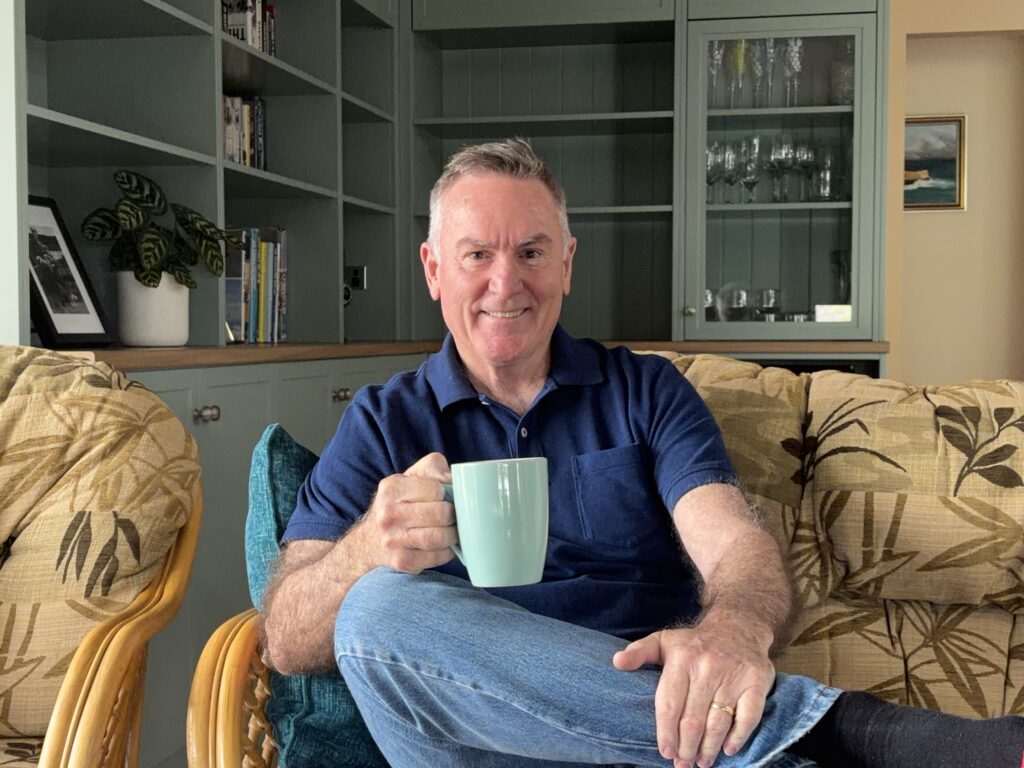
Hit us with the personal stuff first, we’re intrigued to learn more about your own background and experience with alcohol?
I grew up in an outer southern suburb of Adelaide in the 1960s and 70s, mum, my two brothers and me. Weekends we disappeared from sun up to sun down, yabbying in the creek, riding pushbikes everywhere, sliding down Billy Goat Hill on bits of cardboard. My dad had left the family home when I was eight. Just when I was getting to know him, he was moving out, and my biggest concern at the time was who was going to look after him. His new girlfriend, as it turned out.
Alcohol wasn’t really a thing in our house. Dad used to attend “Church” on Sunday afternoons at the neighbours, a few beers, no kids allowed. I still remember my mum at 4am one New Year’s Day, singing “I’m Going to Knock on Your Door” with a neighbour, collapsing into laughter and starting again. I wandered into the lounge room that morning to a room full of half empty glasses, some with multiple cigarette butts in them. My stomach still does a little retch thinking about it.
In fourth year of high school, I learned about an Air Force trade apprenticeship for young men 15 to 17, so I joined at 16. It was exciting and scary, but it’s where I wanted to be. We learned to march and drill, polish shoes, press uniforms, boys in a men’s world. Weekends were our own and boys being boys, although somewhat underage, we got attracted to alcohol we couldn’t legally buy. We’d bribe a senior to grab us a carton and have a room party. I didn’t particularly like the taste but everyone else was doing it, and it usually devolved into silliness once inhibitions dropped. We’d knock back a few quickly to get the party going and mitigate being caught by Service Police, who’d have confiscated whatever was left.
The patterns set in those early years followed me through a 21-year Air Force career and into civilian life. First few drinks fast, no off switch, last to leave, things I regretted the next day. Just being one of the boys. The warning signs were there the whole time, but I was a slow learner, and I kept drinking that way for decades until it caught up with me.
In 2007 I sat up late one Sunday night drinking a disgusting clean skin wine I found at the back of my bar after my beers ran out. Didn’t like it at all, drank most of it anyway, just because it was alcohol. Could have been aviation hydraulic oil, the colour and texture of it. The next day I was so sick I didn’t go to work, and decided I had to give this game away before something worse happened. I looked at AA, decided a small town version of it wasn’t for me, and instead went cold turkey on my own. White knuckling and isolation were the strategy. Months of avoiding anywhere alcohol was served, pushing down cravings whenever they surfaced, slowly easing back into a life that didn’t revolve around it.
In late 2015 a friend and mentor passed away suddenly, this time the old pushdown trick didn’t work. One afternoon I snuck into the shed and drank again for the relief. Within a short time I was back to the exact same bingeing behaviour from nine years earlier. It was like a switch flicked and everything came flooding back. I drank that way for another five years, until the joy just seemed to evaporate out of my life. Nothing excited me enough to put a beer down and go do it, not even flying my own aircraft, which had never happened before. By then I was sixty-two.
After mustering up the courage to try again, I started googling. I found Annie Grace’s book This Naked Mind, and the word “control” in the subtitle was what piqued my curiosity. I read it several times, did a 30-day Alcohol Experiment, and although challenging I think I found it easier than I expected. I’d already lived through every “first” alcohol-free event the first-time round. What changed overall was my mindset. I now get “to” do all the things, instead of I can’t “have” that one thing. Early on I thought about trying moderation again, but with what I now understood about alcohol, it so wasn’t worth it. My life is so much better without it.
Now let’s cover off on the credentials – what makes you qualified to work in this specialised field of coaching?
A year after giving alcohol away I became Certified This Naked Mind Coach, working as an Alcohol Freedom Coach ever since. During my Airforce career and the corporate IT career that followed, I specialised in education and training. Coaching felt a natural extension of those career choices. After my years of trying to control or quit alcohol the hard way, then finding a new way that made total sense, both logically and practically, I felt I could help other people find their freedom from alcohol. I’ve done the hard yards so my clients don’t have to. I can see the same patterns clearly in others who are trying to control their drinking and becoming despondent when it doesn’t work out. I lived that for so many years. I know first-hand what it’s like to feel ashamed, lose trust in yourself and then try to pull yourself out of the hole. But it can be done and the really cool thing is that you don’t have to do it alone.
Qualifications
• Certified This Naked Mind Alcohol (TNM) Coach
• Certified TNM Affective Liminal Psychology
• 2 drinking careers that no qualification covers
If I was to work with you, what should I expect?
All of my alcohol freedom coaching sessions are done online. We start with understanding, curiosity and cultivate an experimenter mindset. Exploring your drinking history as information, data that helps us understand what’s actually going on, not something to feel judged or guilty about. Seeking to understand the triggers, responses and subconscious beliefs hiding underneath the drinking behaviour. What does alcohol actually represent in your life, relief, reward, social passport, all of the above?
Weekly coaching sessions are combined with learning through my online video or private podcast lessons, covering subjects like what alcohol is and isn’t, how the body and brain react to it, what we think it does for us and why at 5 o’clock we tend to reach for a drink even though we started the day with a different intention. When you know what you’re really working with, choices and action become possible in a way they weren’t before.
If we are experimenting say, with setting an intention to only have two alcoholic drinks at the pub and it doesn’t go to plan, we treat it as a data point. What happened, what was underneath it and what does it tell us about what still needs working on. The coaching is personal and empathetic, customised to your needs at the time we meet. It underpins the learning, offering new perspective on what you’re experiencing, seeing it now through new information instead of the old patterns you’ve been stuck in.
Men who’ve spent years in the willpower cycle often expect to be evaluated against some standard of how quickly they should be getting this. That’s not how this works.
With that in mind, my recommended pathway at time of interview is “The men’s guide to drinking less” course with 8 weekly coaching sessions. 8 modules with coaching designed to prepare you to take an extended break from alcohol. This is followed by the “The men’s 30-day breakaway” course designed to support you through 30-day break. This can also be teamed up with 6 coaching sessions for support and accountability.
The two courses can also be taken as standalone online video or podcast format lessons at any time if a DIY approach is preferred. You can also opt back in to coaching sessions if DIY isn’t suitable. Similarly, you can go for a coaching only option of however many sessions you require.
The goal isn’t white-knuckled sobriety at all costs, been there, done that. My approach centres on understanding your own drinking, at your own pace, without labels or pressure.
It’s arriving at a point where alcohol simply no longer makes sense for you.
Where the conversation in your head quietens down because there’s nothing about alcohol left to negotiate, only firm choices and action. You may decide to take a longer break or try moderating your drinking, either way, by the time our sessions are finished your choice will be an informed one.
What sort of people do you normally work with?
The typical client I work with and most relate to are men over 40 and have been drinking for many years.
On the surface, most of these men are doing well by any normal measure. They have careers, families, respect from the people around them. Nothing that would make anyone think there’s an issue. The drinking just built up slowly over years, a bit more here, a bit more there, until one day they notice how much of their week and weekend activities centre around it. They don’t identify as an alcoholic because the image in their mind does not fit the picture of who they are. What they want is to understand why they spend so much energy trying to manage their drinking, why it’s happening at all, and how to get back to drinking less or not at all. Done without turning it into a fight with themselves every single day. I know that because I lived it before I ever coached anyone through it.
Why would I choose you to work with?
Male alcohol coaches are underrepresented in Australia. Currently I’m the only certified TNM coach in the country working exclusively as a men’s alcohol freedom coach. I came to this through my own life experiences, not a textbook or Instagram reel. I’ve been that guy negotiating himself down to just one, then negotiating himself into needing more, usually in the same night.
For me the key to living a life without any desire at all for alcohol is through knowledge and understanding, that’s what I’m here for.
I’m not here to get a man to quit drinking or push abstinence as the only measure of success. Some end up drinking far less, some stop altogether, some find a version of moderation that sticks. What matters is that the decision comes from clarity, not from white-knuckling through yet another attempt at willpower and discipline.
How can people wanting to work with you get in touch?
The next best step is a private discussion Strategy Call with Tony Richardson
NoLo Life thanks Tony for giving us deeper insight into his life and coaching practice.
You can review profiles of other ABC Coaches and Therapists in our Individual Support Directory.
